
Example. This company doesn't exist: it's here to show an admin app you can actually use. Real client projects are in the work section.
Noria Admin
An example, not a client. Noria is an invented coffee roaster, made up to show what a custom admin app changes in a small business, the kind where evenings go to a spreadsheet, Word invoices and leave requests by text message. The app itself is real and you can use it.
Why an example
The internal tools I build stay with my clients: their invoices, their staff and their numbers are not for show. So Noria is an invented company with invented data, so you can open an admin app and click everywhere without breaking anything. Everything below comes from the data inside the app: you can check every figure by opening it.
The company
Noria Torréfaction is a small company at 42 rue de la Navigation, in Lyon. Eight people: Camille Roussel runs it, Hugo Lambert and Théo Marchand roast, Inès Benali and Sarah Nguyen sell, Léa Fontaine keeps the books, Malo Guérin and Noé Perrin handle logistics, one on a fixed-term contract, the other an apprentice.
Noria doesn’t sell to the public. It supplies seven businesses in the region: Café Lumen and the La Halle coworking space in Lyon, Hôtel Bellerive in Annecy, Boulangerie Pasquier & Fils in Villeurbanne, Épicerie Verveine in Grenoble, Restaurant Le Quai 12 in Valence, Bistrot Marcelle in Saint-Étienne. Six lines in the catalogue: three coffees in 1 or 5 kg bags, a water-process decaf, espresso machine servicing at €140, and a half-day barista course at €320. Payment at thirty days, VAT at 20%.
Before the app
It’s the story of many small businesses. Invoices were made from a Word template and numbered by hand. Payment tracking lived in a spreadsheet only the accountant dared to open. Leave was requested by text, and on Monday morning someone discovered that two people from logistics were off the same week. Nobody knew, without spending an hour on it, how much money was still out.
What the app does
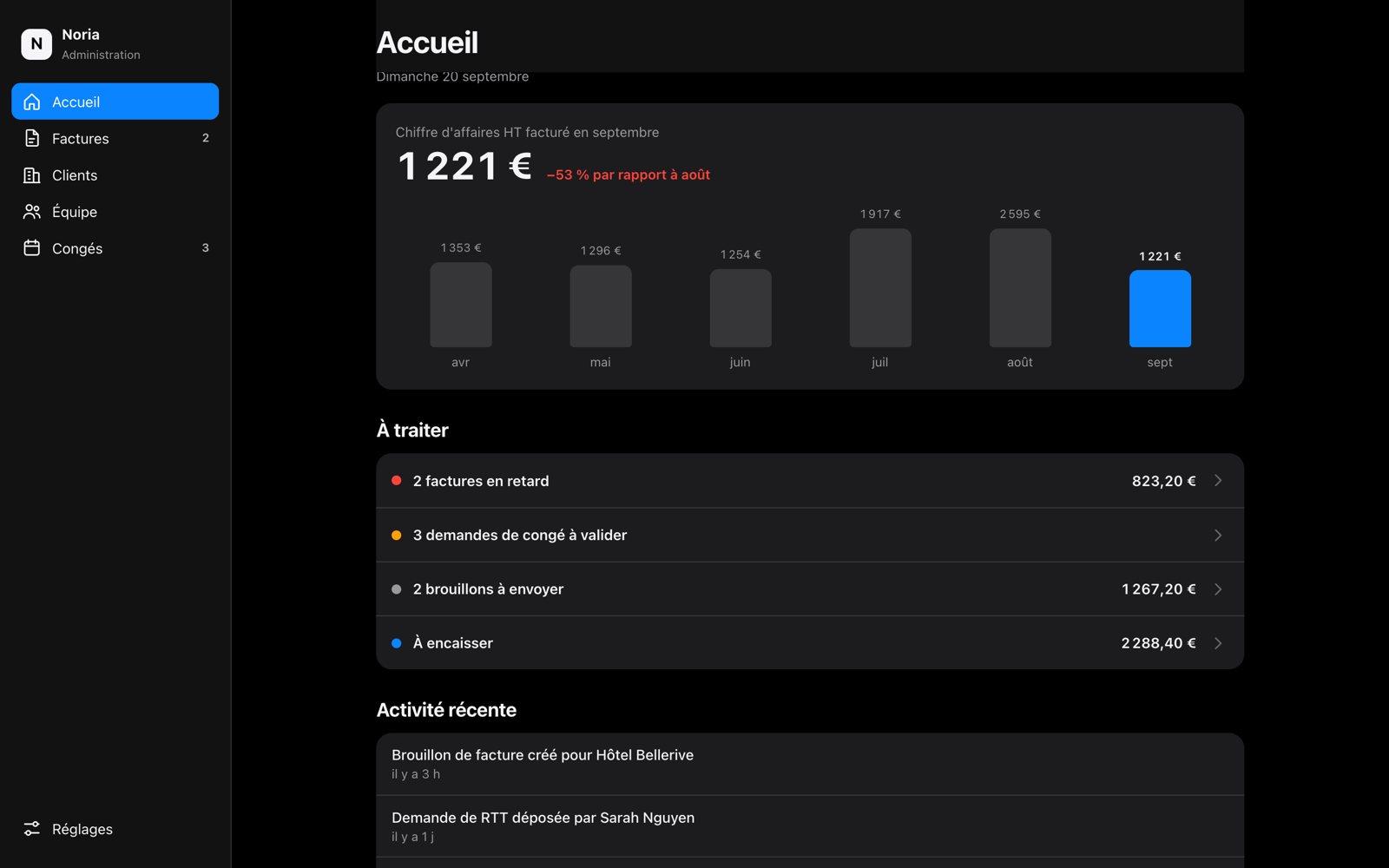
- A home screen that says what to do. This month’s revenue against the five before it, then a “To do” list: late invoices, leave to approve, drafts to send, amount to collect. Tap a line, land in the right place.
- Invoices. Created in a few taps from the catalogue, numbered automatically, VAT and due date calculated, with draft, sent, paid and late statuses. An invoice marks itself late once the due date has passed.
- Clients. One record per client, with contact, address and everything they have ordered.
- The team. Eight records: role, department, contract, seniority, leave balance.
- Leave. Each employee submits a request, management approves or declines, the balance updates.
- On phone and computer alike. The same app, a tab bar at the bottom on mobile, a sidebar on large screens. Everything is saved on the device.
Where it makes money
Open the app: here is what it shows, with Noria’s data.
- €823.20 has been outstanding for more than thirty days. Two invoices, Le Quai 12 and Boulangerie Pasquier. In a spreadsheet, you have to look for them. Here, it’s the first line of the home screen, in red. A reminder sent the same day is cash coming in instead of sleeping.
- €1,267.20 is ready to go and hasn’t gone. Two drafts, including two barista courses for Hôtel Bellerive. An invoice that isn’t sent is never paid: the app keeps it in view until it’s out.
- €2,288.40 is still to collect in total. Camille knows this figure by opening her phone, before deciding on a green-coffee order or a new hire.
- One client is a third of the business. Out of €9,636 invoiced before tax in six months, Café Lumen accounts for €3,231. That’s management information: you look after that client, and you know you need others.
- Three leave requests are waiting for an answer. Approved from the app, with everyone’s balance in view, rather than lost in messages. Fewer oversights, no empty workshop during a big order week.
- Admin time. An invoice is created from the catalogue instead of being retyped. Over twenty invoices in six months it’s not a revolution: it’s one evening a month given back to the accountant, and numbering mistakes that disappear.
What it says about a real project
An app like this isn’t sold off the shelf: it’s designed from what you already do, screen by screen. Yours would have your products, your statuses, your leave rules, your accounting export, your automatic email reminders. Noria shows the principle: a tool that tells you every morning where the money is and what’s waiting for a decision.
Stack
HTML, CSS and JavaScript written by hand, in a single 56 KB file, with no dependencies. Light and dark themes, phone and desktop layouts, data kept on the device. For a real client, the same interface connects to a database and user accounts.